Eating lab-grown meat would be good for the planet and would reduce the horrific suffering of the billions of animals slaughtered every year. But it wouldn’t be good for some people.
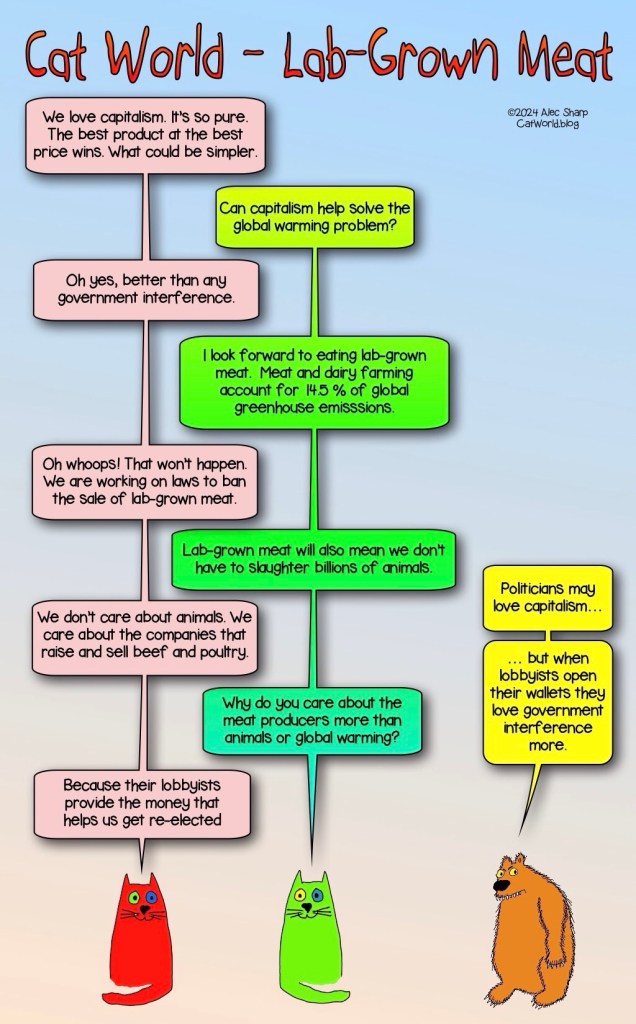
Eating lab-grown meat would be good for the planet and would reduce the horrific suffering of the billions of animals slaughtered every year. But it wouldn’t be good for some people.
 Cat World
Goodness! Have you ever seen the equipment and infrastructure needed for a small experimental artificial meat factory? Imagine scaling that up. The energy requirements will dwarf the carbon footprint of natural meat. Can’t outdo the efficiency of grass fed livestock. The main problem with livestock is its typical industrial production— huge feedlots and feed with huge fertilizer, pesticide, and other carbon based inputs.
LikeLiked by 1 person
But manufacturing processes improve over time.
LikeLike
Yup. Just like the many failed advanced energy processes I’ve encountered. Synthetic fuels: heavily subsidized, 3 or 4 modest scale plants built in the US. None still operating. Exxon once foresaw an industry of 2+ million barrels per day. Based a tiny proof of concept, Union Oil received guaranteed purchase agreements from DOD for jet fuel extracted from oil shale near Rifle CO (not to be confused with shale oil from fracking). The modest 10,000 barrel per day plant never operated more than 50% of the time and finally closed. Exxon itself abandoned its 50,000 barrel per day plant near Rifle before it was complete. Dozens of plans. Nothing to show because the proof of concept plants never scaled.
The artificial meat technology is much more complex. It will never be more than a curiosity.
Soylent Green Forever! 😉
LikeLiked by 1 person